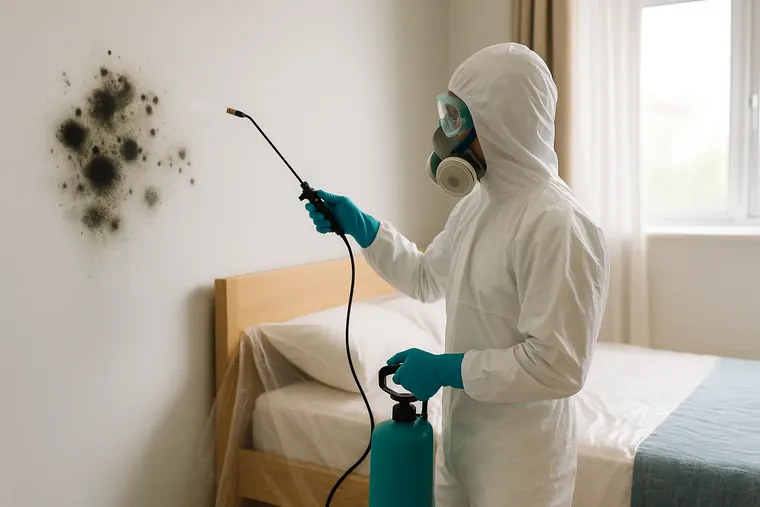
Since Awaab's Law came into force for social housing, many private landlords have asked the same two questions. Does it apply to me? And if not, do I need to do anything yet? The short answers are: not yet, and yes. This guide sets out the position as of October 2026 and what a sensible private landlord can do now.
General information, not legal advice. This article summarises the law and published government material as we understand it. It is not legal advice. For decisions about a specific property or tenancy, speak to a solicitor or your local authority's private housing team.
What Awaab's Law is
Awaab's Law is named after Awaab Ishak, who died in December 2020 in Rochdale after prolonged exposure to mould in his family's social housing flat. It is set out in the Hazards in Social Housing (Prescribed Requirements) (England) Regulations 2025 and has been in force for social housing since 27 October 2025.
The first phase covers emergency hazards and significant damp and mould hazards. Social landlords must:
- investigate and make safe emergency hazards within 24 hours;
- investigate significant hazards within 10 working days of becoming aware of them;
- give the tenant a written summary within 3 working days of the investigation concluding;
- complete relevant safety work within 5 working days of the investigation;
- offer suitable alternative accommodation if the safety work cannot be done in time.
A second phase from 30 November 2026 adds further hazards, such as excess cold and fire, and a later third phase extends the regime to the remaining hazards in the Housing Health and Safety Rating System, except overcrowding.
What already applies to private landlords
The absence of Awaab's Law in the private sector does not mean damp and mould are unregulated. Two pieces of legislation already apply to private lets in England.
The Housing Health and Safety Rating System
The Housing Health and Safety Rating System (HHSRS), introduced under the Housing Act 2004, is how local authorities assess hazards in homes. Damp and mould growth is one of its 29 hazards. If a council officer inspects a property and finds a serious hazard, the council can take enforcement action, including serving an improvement notice requiring the landlord to carry out specified work.
The Homes (Fitness for Human Habitation) Act 2018
This Act lets tenants take action in court where a home is not fit for human habitation. Serious damp and mould can make a property unfit. Unlike HHSRS enforcement, this route does not depend on the council: the tenant can bring the claim themselves.
The end of section 21
Since 1 May 2026, the first phase of the Renters' Rights Act 2025 has been in effect, abolishing section 21 "no fault" evictions for private tenancies. In practice this means ending a tenancy is no longer a straightforward way out of a disrepair dispute. Fixing the problem and documenting the fix is now the realistic path in almost every case.
| Duty or measure | Applies to private lets? | Status |
|---|---|---|
| HHSRS (Housing Act 2004) | Yes | In force; councils can serve improvement notices |
| Homes (Fitness for Human Habitation) Act 2018 | Yes | In force; tenants can take court action |
| Section 21 abolition (Renters' Rights Act 2025) | Yes | In effect since 1 May 2026 |
| Awaab's Law timescales | Not yet | Power to extend exists; no start date set |
| Decent Homes Standard | Not yet | Government has proposed 2035 or 2037 |
What the Renters' Rights Act 2025 changes
The Renters' Rights Act 2025 received Royal Assent on 27 October 2025. Among much else, it gives the government power to apply Awaab's Law style requirements to privately rented homes. That would mean fixed timescales for investigating and fixing hazards such as damp and mould, rather than the general expectation to act reasonably that applies now.
The Act also brings other changes that touch damp and mould indirectly:
- A private rented sector database. The government's implementation roadmap says roll-out will begin from late 2026.
- A landlord ombudsman. The roadmap expects mandatory sign-up in 2028, after the database is introduced. Once running, tenants will have a route to complain about landlords outside the courts.
- The Decent Homes Standard. The government has proposed applying it to private rented homes in either 2035 or 2037, with dates to be settled after consultation.
What is still unknown
The most important gap is timing. No start date has been set for Awaab's Law in the private rented sector. The government's roadmap lists it as subject to consultation, and current guidance points to 2027 at the earliest. Also still to be confirmed:
- whether the private sector timescales will match the social housing ones or be adapted;
- which hazards will be covered first;
- how the duties will apply to agents acting for landlords;
- what enforcement will look like in practice.
Until the consultation and regulations are published, anyone quoting specific private sector deadlines or penalties is guessing. Treat confident claims with caution.
How to prepare now
The good news is that the steps that will help under a future Awaab's Law are the same ones that protect you under the current law. None of them depend on the final details.
Set your own response times
Decide how quickly you, or your agent, will acknowledge a damp or mould report, arrange an inspection and confirm the findings to the tenant. Using the social housing timescales as a working benchmark is a reasonable starting point, and it means little will need to change if similar rules arrive.
Find the cause, not just the mould
Wiping or painting over growth does not resolve a hazard. An inspection with moisture readings and ventilation checks identifies whether the problem is condensation, a leak or water getting in from outside, and that decides the repair. Our guide on telling condensation, rising damp and leaks apart covers the signs.
Keep a file for every report
For each case, keep the date it was reported, what you did and when, dated photographs, readings, the contractor's findings, the works carried out and what you told the tenant. If a council officer, a court or, in future, an ombudsman asks what you did once you knew, this file is your answer.
Check your agent's process
If a letting agent manages the property, ask how they log and escalate damp reports, what spending limit they can approve without you and how quickly they pass reports on. Gaps in the chain between tenant, agent and landlord are where delays usually happen.
Look at known problem properties first
Older properties with solid walls, flats with a history of condensation complaints and homes without working extract ventilation are the obvious candidates for attention before winter. Dealing with them proactively is cheaper and calmer than reacting to a complaint.