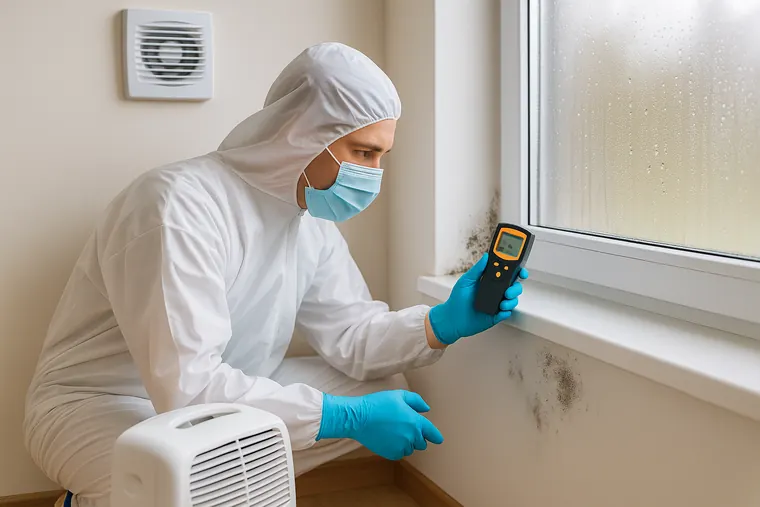
A mould complaint usually arrives as a short message with a photograph attached. How it is handled from that moment decides whether it becomes a one-visit job or a long running dispute. The process below is written for letting agents and landlords managing private lets, with notes where the rules for social housing differ.
A note on timescales
For social housing, Awaab's Law sets fixed deadlines. Emergency hazards must be investigated and made safe within 24 hours. Significant damp and mould hazards must be investigated within 10 working days of the landlord becoming aware, the tenant must receive a written summary within 3 working days of the investigation concluding, and safety work must be completed within 5 working days of the investigation.
For private lets there are no equivalent fixed deadlines yet. The Renters' Rights Act 2025 allows them to be introduced, but no start date has been set. That does not mean there is no expectation. Councils can act under the Housing Health and Safety Rating System, and tenants can bring claims under the Homes (Fitness for Human Habitation) Act 2018. In both cases, how promptly you acted and what you can show will matter. Using the social housing timescales as an internal target is a sensible benchmark.
Step 1: Log the report the moment it arrives
Record the date and time, how it came in (email, portal, phone, WhatsApp) and exactly what the tenant said. If it came by phone, write a short note and email it back to the tenant to confirm. The date you became aware is the starting point for everything that follows, so it needs to be clear.
Step 2: Acknowledge and ask the right questions
Reply the same day if you can. A short acknowledgement that says what happens next does more to calm a situation than a long reply sent later. At the same stage, ask for:
- photographs of each affected area, plus a wide shot of the room;
- which rooms are affected and how long it has been there;
- whether it is getting worse, and whether it changes with the weather;
- any leaks, drips or water stains they have noticed;
- whether anyone in the household is pregnant, very young, elderly or has a health condition such as asthma;
- times when access is possible over the next few days.
Step 3: Triage
Use the answers to decide how fast to move. Treat a case as urgent if there is an active leak, water near electrics, extensive growth across a room, or vulnerable occupants reporting symptoms. Small, recent patches in a bathroom with no other concerns can usually follow your standard timescale, but should still be inspected rather than left.
Agents should check the management agreement at this point. If the spending limit allows it, instruct the inspection straight away rather than waiting for landlord approval. If not, send the landlord the report and photographs the same day with a clear recommendation.
Step 4: Arrange an inspection
Instruct a contractor who will investigate the cause, not just treat the surface. Give them the tenant's report, photographs, contact details and access notes. If your contractor can contact the tenant directly to book access and copy you in, it saves several rounds of messages. Record the date you instructed them and the date of the visit.
If the tenant does not respond to access requests, keep a record of each attempt: date, method and what was said. Repeated, documented attempts to gain access are part of showing you acted reasonably.
Step 5: Get a diagnosis in writing
The inspection should produce dated photographs, moisture readings, a likely cause and recommendations. Our guide on what a damp and mould report should contain sets out what to look for. Without a written cause, you cannot decide on the right repair or explain it to the tenant.
Step 6: Tell the tenant what was found
Send the tenant a short written summary in plain language: what was found, the likely cause, what work will be done, when, and anything they are being asked to do. Social landlords must do this within 3 working days of the investigation concluding. Private landlords and agents are not bound by that deadline yet, but the same habit works well.
Tone matters. If condensation is part of the cause, explain it with the evidence from the report and pair any advice to the tenant with what you are doing on your side, such as fixing an extractor fan. Advice alone, with no action from the landlord, reads as blame.
Step 7: Carry out the works
There are usually two parts: removing and treating the mould, and fixing what caused it. Both need to happen. Treating the mould without fixing a leaking gutter, or fixing the gutter and leaving mouldy plaster in place, will both bring the tenant back.
Confirm dates with the tenant in writing, explain what to expect on the day (containment, equipment noise, drying time) and record when the work was completed.
Step 8: Follow up and close
A few weeks after the work, contact the tenant to check there is no return of growth. Record their reply. Then close the case with a short note summarising the timeline and attaching the report. If the tenant says it has returned, reopen the case rather than starting a new one, so the history stays together.
Records to keep
| Record | What to capture |
|---|---|
| Initial report | Date, time, channel, tenant's own words, photographs |
| Acknowledgement | Date sent and what was promised |
| Triage decision | Urgency, reasons, any vulnerable occupants |
| Instructions | Date contractor instructed, landlord approval if needed |
| Access attempts | Each attempt, method and outcome |
| Inspection report | Photographs, readings, cause, recommendations |
| Tenant summary | Copy of what was sent and when |
| Works | Scope, dates, completion photographs |
| Follow-up | Date of check and tenant's response |
Keep all of this in one place per property, not spread across inboxes. If a colleague has to pick up the case, or an officer asks for the history, it should take minutes to put together.
Common mistakes
- Sending mould spray instead of an inspection. It looks like action but leaves the cause in place and the case open.
- Painting over growth. The mould returns through the paint, usually within weeks.
- Blaming the tenant first. Even where lifestyle plays a part, opening with blame makes the rest of the process harder.
- Losing the thread between agent and landlord. Delays waiting for approval are a frequent reason cases drag on.
- Closing without follow-up. A case closed on the day of the work has no evidence that the fix lasted.
Handling several properties? A maintenance contract with planned visits and priority booking can take the scheduling off your desk and keep reports consistent across your portfolio.